← All resourcesLaTeX templates
Short Note
A minimal template for short derivations and public notes, built around structure, formulas and white space.
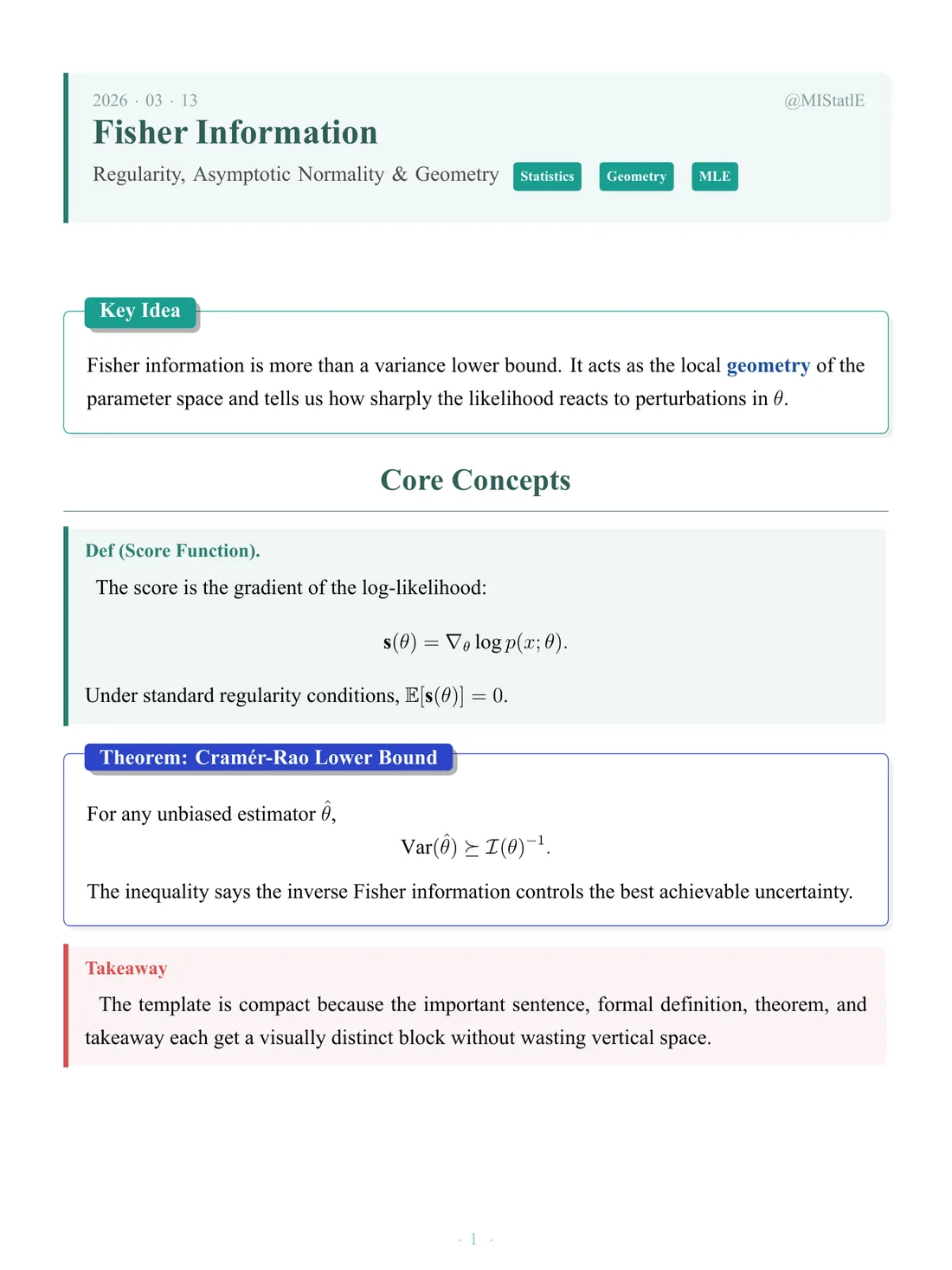
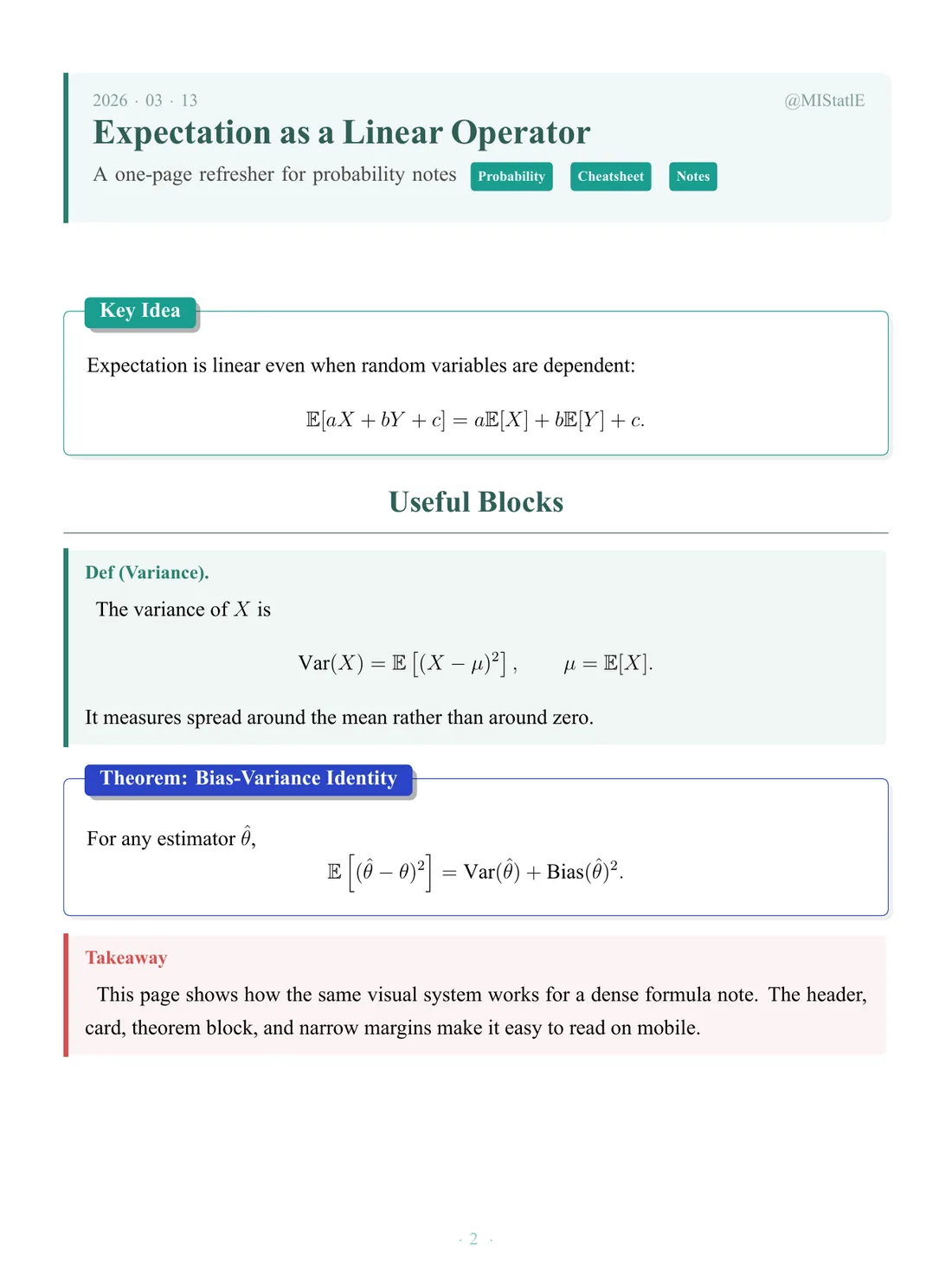
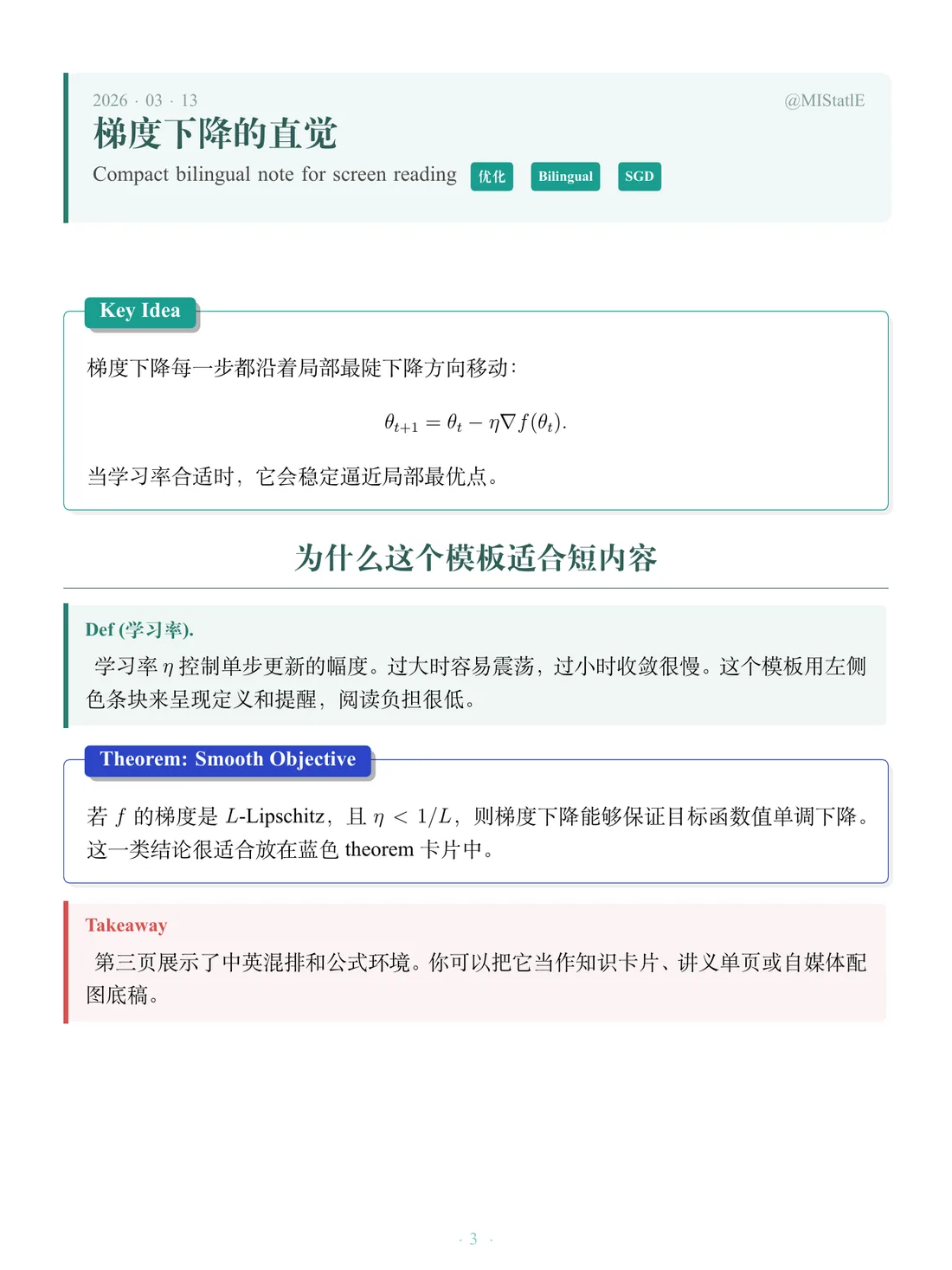
Design
This template is for short derivations and knowledge cards. The standard LaTeX article has wide margins that do not suit short content read on a phone or tablet, so three things were changed:
- Compact page: a 7.5 × 10 inch page with narrow margins, for a high density of information per page.
- Two kinds of boxes:
- Elegant Card: for
Key IdeaandTheorem, a card with a soft shadow. - Notion Style: for
DefinitionandTakeaway, with only a colored bar on the left.
- Elegant Card: for
- Style and content kept apart: the style lives in its own
.texfile, and the main file holds only content.
Requirements
- Compiler:
XeLaTeX(required, for Chinese viactexand fonts viafontspec) - Packages:
tcolorbox(4.50 or later),tikz,geometry
Step 1: create the style file
Create short-template.tex in the project root. This is the style sheet and does not need editing.
% ===========================================
%  File: short-template.tex
%  Description: Style definitions for Short Note
% ===========================================

% --- 1. Packages ---
\usepackage{ifxetex}
\usepackage{geometry}
\usepackage{xcolor}
\usepackage{titlesec}
\usepackage[fontset=fandol]{ctex}
\usepackage{tikz,eso-pic}
\usetikzlibrary{positioning,calc,shadows,shapes.misc}
\usepackage{fancyhdr}
\usepackage[most]{tcolorbox}
\usepackage{amsmath,amssymb,bm,amsthm}
\usepackage{enumitem}
\usepackage{fontspec}

% --- 2. Layout (7.5x10 inch Compact) ---
\geometry{
  paperwidth=7.5in, paperheight=10in,
  left=0.5in, right=0.5in,
  top=0.55in, bottom=0.65in,
  footskip=0.45in
}

% --- 3. Fonts & Colors ---
\setmainfont{Times New Roman}
\linespread{1.3}
\pagecolor{white}

\definecolor{brand}{HTML}{1A9D8F}       % Teal
\definecolor{brandD}{HTML}{2A7F6F}      % Dark Teal
\definecolor{keybg}{HTML}{E8F4F1}       % Light BG
\definecolor{keydark}{HTML}{2F5E58}     % Dark Text
\definecolor{secblue}{HTML}{2B44C6}     % Academic Blue
\definecolor{accentD}{HTML}{D94F4F}     % Alert Red
\definecolor{termblue}{HTML}{1A4C9A}    % Term Blue
\definecolor{ink}{HTML}{1A1A1A}         % Black

% --- 4. Title Styles ---
\titleformat{\section}[block]{\centering\Large\bfseries\color{keydark}}{}{0em}{}[\vspace{0.2em}\titlerule]
\titlespacing*{\section}{0pt}{1.0em}{0.6em}
\titleformat{\subsection}{\large\bfseries\color{brand}}{}{0em}{$\bullet$\ \ }
\titlespacing*{\subsection}{0pt}{0.8em}{0.3em}

% --- 5. Box Styles ---
% [Elegant Style]
\tcbset{
    elegant_style/.style={
        enhanced, breakable, colback=white, colframe=#1,
        fonttitle=\bfseries, coltitle=white,
        attach boxed title to top left={xshift=12pt, yshift*=-10pt},
        boxed title style={colback=#1, frame hidden, arc=3pt, boxrule=0pt, drop shadow={opacity=0.3, shadow xshift=1pt, shadow yshift=-1pt}},
        boxrule=0.5pt, arc=3pt,
        left=10pt, right=10pt, top=14pt, bottom=10pt,
        drop shadow={opacity=0.06, shadow xshift=2pt, shadow yshift=-2pt},
        before skip=10pt, after skip=10pt
    }
}
% [Notion Style]
\tcbset{
    notion_style/.style={
        enhanced, breakable, frame hidden,
        borderline west={3pt}{0pt}{#1},
        colback=#1!7, coltitle=#1, fonttitle=\bfseries\small,
        attach title to upper={\ \ }, after title={\par\vspace{0.2em}},
        left=8pt, right=8pt, top=6pt, bottom=6pt, arc=2pt,
        before skip=6pt, after skip=6pt
    }
}

% --- 6. Environments ---
\newtcolorbox{KeyBox}{elegant_style=brand, title=Key Idea}
\newtcolorbox{Theorem}[1][]{elegant_style=secblue, title=\if\relax\detokenize{#1}\relax Theorem \else Theorem: #1 \fi}
\newtcolorbox{Definition}[1][]{notion_style=brandD, title=\if\relax\detokenize{#1}\relax Def. \else Def (#1). \fi}
\newtcolorbox{Takeaway}{notion_style=accentD, title=Takeaway}

% --- 7. Header Component ---
\newcommand{\padzero}[1]{\ifnum#1<10 0\fi\number#1}
\tcbset{tag_style/.style={on line, boxsep=1pt, left=3pt, right=3pt, top=1pt, bottom=1pt, colback=brand, colframe=brand, fontupper=\bfseries\scriptsize\color{white}, arc=2pt, boxrule=0pt, valign=center, before upper=\strut}}

\newcommand{\MakeShortHeader}[3]{
    \noindent
    \begin{tikzpicture}
        \node[fill=keybg!60, rounded corners=6pt, inner sep=12pt, minimum width=\linewidth, text width=\dimexpr\linewidth-30pt\relax, align=left] (box) {
            {\footnotesize \color{keydark!60} \the\year·\padzero{\the\month}·\padzero{\the\day} \hfill @MIStatlE} \\
            \vspace{0.2em}
            {\fontsize{20pt}{24pt}\selectfont\bfseries\color{keydark} #1} \\[0.2em]
            {\normalsize\color{ink!80} #2}
            \vspace{0.5em}
            \foreach \T in {#3} { \tcbox[tag_style]{\T}\hspace{0.2em} }
        };
        \draw[brandD, line width=3pt] (box.north west) -- (box.south west);
    \end{tikzpicture}
    \vspace{1.0em}
}

% --- 8. Macros ---
\newcommand{\Term}[1]{\textcolor{termblue}{\textbf{#1}}}
\fancyhf{} \renewcommand{\headrulewidth}{0pt} \fancyfoot[C]{\footnotesize\color{brand!50} · \thepage \ ·} \pagestyle{fancy}Step 2: write your content
Create main.tex, load the style with \input, and write. The sample content is in Chinese.
\documentclass[12pt]{article}

% 1. Import the style template
\input{short-template.tex}

\begin{document}

% 2. Generate Header (Title, Subtitle, Tags)
\MakeShortHeader
  {Fisher Information}
  {Regularity, Asymptotic Normality \& Geometry}
  {Statistics, Geometry, MLE}

% 3. Use Pre-defined Environments
\begin{KeyBox}
    Fisher Information is not just the variance bound; it is the intrinsic \Term{Riemannian Metric} of the parameter space.
\end{KeyBox}

\section{Core Concepts}

\begin{Definition}[Score Function]
    The gradient of the log-likelihood: $\mathbf{s}(\theta) = \nabla_\theta \log p(x;\theta)$.
    It has the property $\mathbb{E}[\mathbf{s}(\theta)] = 0$.
\end{Definition}

\begin{Theorem}[Cramér-Rao Lower Bound]
    For any unbiased estimator $\hat{\theta}$:
    \[ \text{Var}(\hat{\theta}) \ge \mathcal{I}(\theta)^{-1} \]
\end{Theorem}

\begin{Takeaway}
    In high-dimensional spaces, the curvature of the log-likelihood (Fisher Info) determines the convergence speed of SGD.
\end{Takeaway}

\end{document}