← 全部资源LaTeX 模板
CN Lecture Note
面向中文课程讲义与系列笔记,统一正文层级、定理环境与长篇阅读节奏。
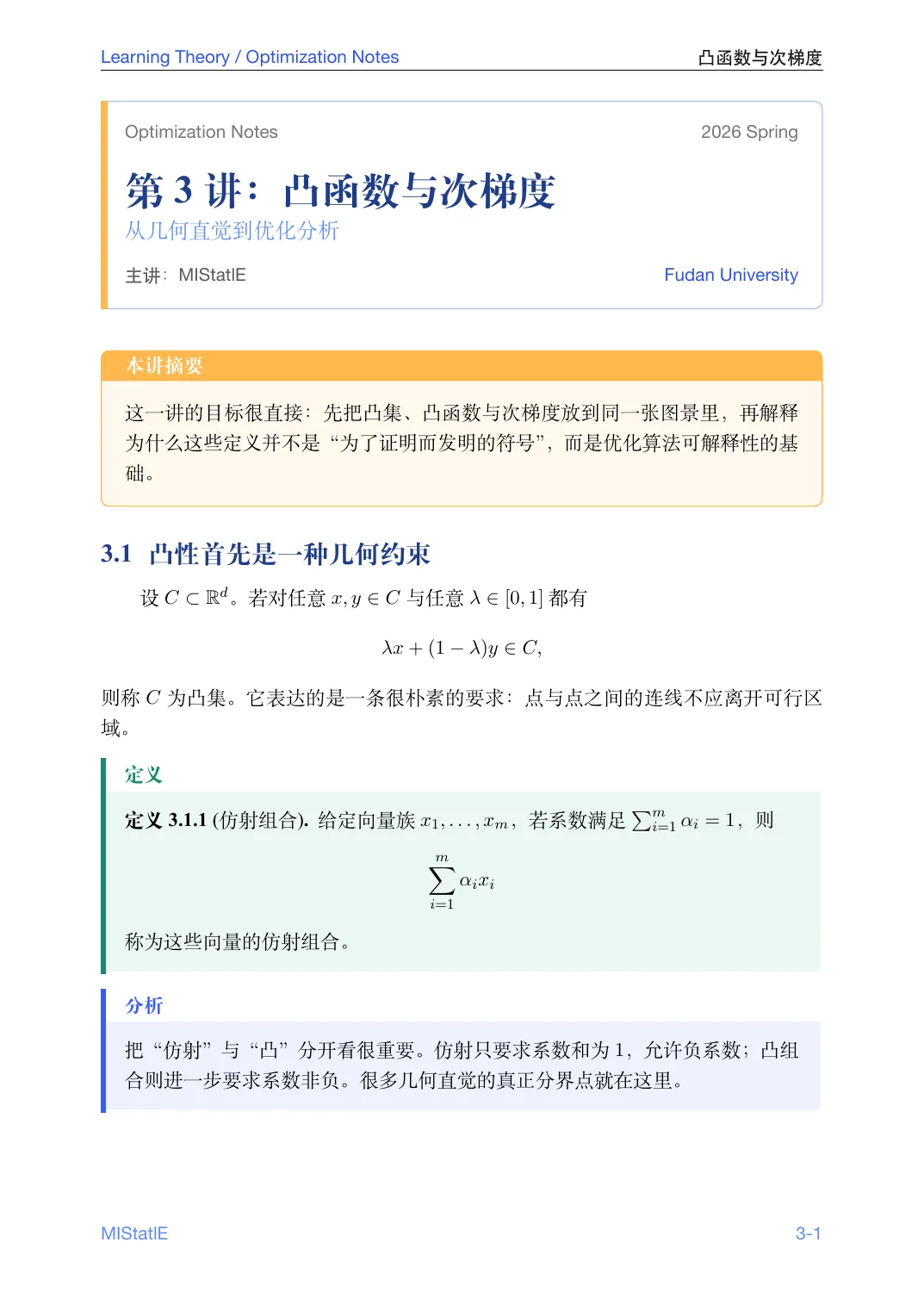
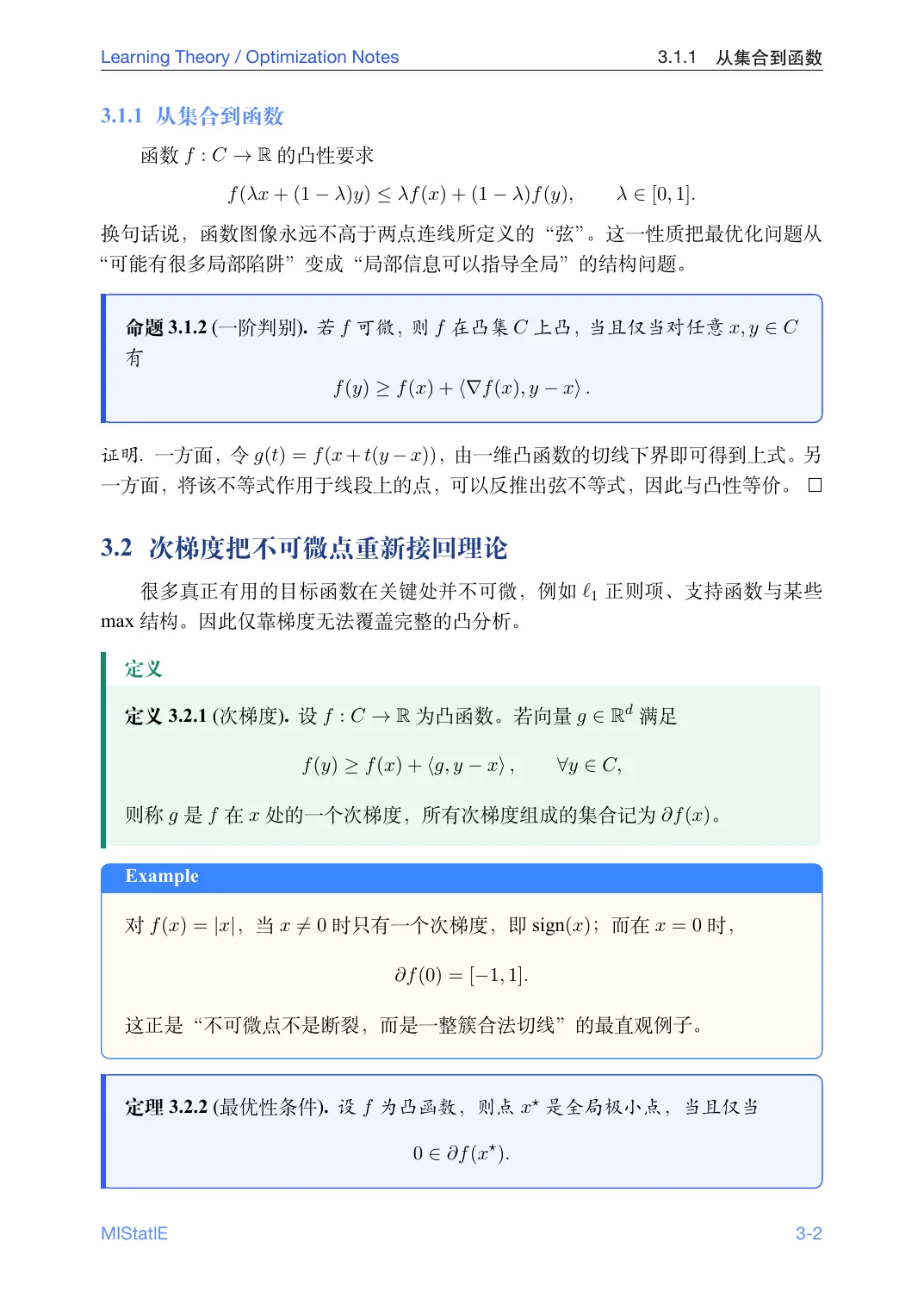
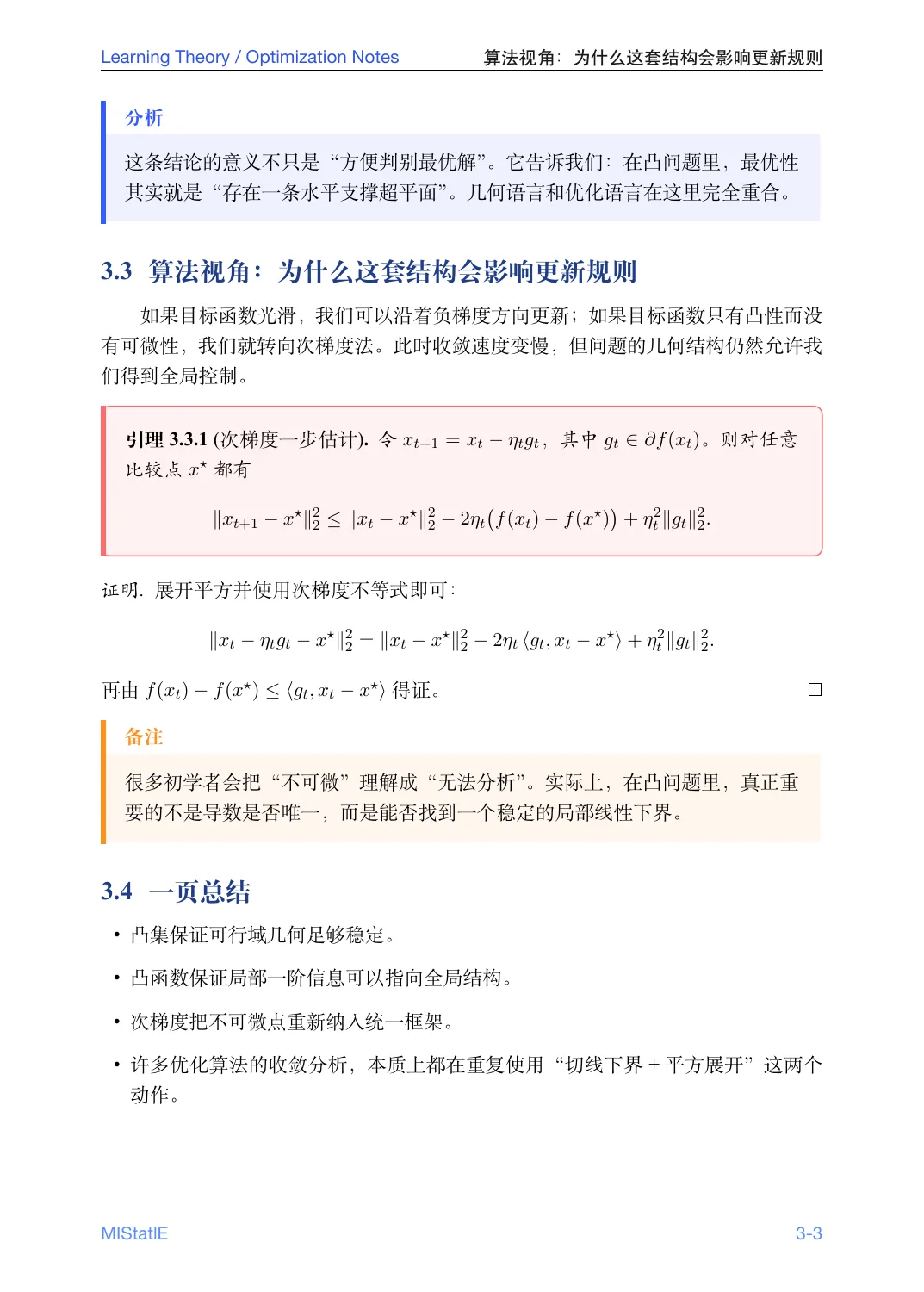
设计思路
这套模板面向 课程讲义、系列笔记和长篇推导,介于单页卡片和整本书之间:
- 按讲次编号:页码、公式和章节编号都可以按 lecture 组织,适合连续更新。
- 首页信息集中:用一块讲义头部面板放课程、学期、讲次、副标题和作者。
- 统一的定理与说明环境:
definition / theorem / proposition / remark都套在tcolorbox里,Analysis / Remark / Summary / Example共用同一套盒子。 - 为中文技术写作准备:默认
XeLaTeX / LuaLaTeX + ctex,并带字体回退,换一台机器也能编译。
环境要求
- 编译器:
XeLaTeX或LuaLaTeX - 宏包:
ctex,fontspec,tcolorbox,titlesec,fancyhdr,tikz,mathtools,amsthm,cleveref - 推荐字体:
- 英文衬线:
Times New Roman,回退到TeX Gyre Termes - 中文衬线:
Noto Serif CJK SC,回退到Fandol
- 英文衬线:
源文件
用法
源文件本身就是一份可以直接编译的示例:
- 替换
\LectureBanner里的课程名、讲次和作者信息。 - 保留或删除示例章节。
- 在
definition / theorem / AnalysisBox / SummaryBox这些环境里写内容。
完整源码(CN.tex)
\documentclass[11pt]{article}

\usepackage{iftex}
\ifPDFTeX
  \errmessage{Please compile with XeLaTeX or LuaLaTeX}
\fi

\usepackage[fontset=fandol]{ctex}
\usepackage{fontspec}
\usepackage{geometry}
\usepackage{xcolor}
\usepackage{microtype}
\usepackage{hyperref}
\usepackage{titlesec}
\usepackage{fancyhdr}
\usepackage{tikz}
\usetikzlibrary{positioning}
\usepackage[most]{tcolorbox}
\usepackage{amsmath,amssymb,amsthm,mathtools,bm}
\usepackage{enumitem}
\usepackage{booktabs}
\usepackage[capitalize,nameinlink]{cleveref}

\geometry{
  paperwidth=7.15in,
  paperheight=10in,
  left=0.78in,
  right=0.78in,
  top=0.78in,
  bottom=0.8in,
  headsep=0.24in,
  footskip=0.4in
}

\IfFontExistsTF{Times New Roman}{\setmainfont{Times New Roman}}{\setmainfont{TeX Gyre Termes}}
\IfFontExistsTF{Helvetica Neue}{\setsansfont{Helvetica Neue}}{\setsansfont{TeX Gyre Heros}}
\IfFontExistsTF{JetBrains Mono}{\setmonofont{JetBrains Mono}}{\IfFontExistsTF{Menlo}{\setmonofont{Menlo}}{\setmonofont{Courier New}}}
\IfFontExistsTF{Noto Serif CJK SC}{\setCJKmainfont{Noto Serif CJK SC}}{}
\IfFontExistsTF{Noto Sans CJK SC}{\setCJKsansfont{Noto Sans CJK SC}}{}

\linespread{1.24}
\setlength{\parindent}{1.6em}
\setlength{\parskip}{0.15em}

\definecolor{brand}{HTML}{5B8CFF}
\definecolor{brandD}{HTML}{2F54EB}
\definecolor{themegreen}{HTML}{1DBA8C}
\definecolor{themegreenD}{HTML}{178A69}
\definecolor{ink}{HTML}{1A1A1A}
\definecolor{keybg}{HTML}{EFF4FF}
\definecolor{keydark}{HTML}{1F3C88}
\definecolor{accent}{HTML}{FFB84D}
\definecolor{accentD}{HTML}{FF8F1F}
\definecolor{soft}{HTML}{FFFBF2}
\definecolor{xhsRed}{HTML}{FF6B6B}
\definecolor{xhsDark}{HTML}{1F1F1F}
\definecolor{xhsCream}{HTML}{FFF8EE}
\definecolor{xhsBlue}{HTML}{3A86FF}
\definecolor{xhsYellow}{HTML}{FFC857}
\definecolor{secblue}{HTML}{365CFF}
\definecolor{thmBg}{RGB}{240,245,255}
\definecolor{lemBg}{RGB}{255,242,242}
\definecolor{defBg}{RGB}{235,248,242}

\hypersetup{
  colorlinks=true,
  linkcolor=brandD,
  citecolor=brandD,
  urlcolor=secblue,
  pdfauthor={MIStatlE},
  pdftitle={CN Lecture Note Template}
}

\newcounter{lecnum}
\renewcommand{\thepage}{\thelecnum-\arabic{page}}
\renewcommand{\thesection}{\thelecnum.\arabic{section}}
\renewcommand{\thesubsection}{\thelecnum.\arabic{section}.\arabic{subsection}}
\renewcommand{\theequation}{\thelecnum.\arabic{equation}}
\numberwithin{equation}{section}

\titleformat{\section}
  {\Large\bfseries\color{keydark}}
  {\thesection}{0.6em}{}
\titlespacing*{\section}{0pt}{1.1em}{0.45em}

\titleformat{\subsection}
  {\large\bfseries\color{brand}}
  {\thesubsection}{0.55em}{}
\titlespacing*{\subsection}{0pt}{0.9em}{0.3em}

\setlist[itemize]{leftmargin=1.5em,itemsep=0.25em,topsep=0.4em}
\setlist[enumerate]{leftmargin=1.7em,itemsep=0.25em,topsep=0.4em}

\newcommand{\LectureSeries}{Learning Theory / Optimization Notes}
\newcommand{\LectureSpeaker}{MIStatlE}
\newcommand{\LectureAffiliation}{Fudan University}

\fancyhf{}
\renewcommand{\headrulewidth}{0.4pt}
\fancyhead[L]{\small\sffamily\color{brandD}\LectureSeries}
\fancyhead[R]{\small\sffamily\color{ink}\nouppercase{\rightmark}}
\fancyfoot[L]{\small\sffamily\color{brand}\LectureSpeaker}
\fancyfoot[R]{\small\sffamily\color{brand}\thepage}
\pagestyle{fancy}
\fancypagestyle{plain}{\pagestyle{fancy}}
\renewcommand{\sectionmark}[1]{\markright{#1}}

\tcbset{
  cn-panel/.style={
    enhanced,
    breakable,
    boxrule=0.7pt,
    arc=4pt,
    left=10pt,right=10pt,top=10pt,bottom=10pt
  },
  cn-soft/.style={
    enhanced,
    breakable,
    frame hidden,
    borderline west={3pt}{0pt}{#1},
    colback=#1!8,
    left=9pt,right=9pt,top=8pt,bottom=8pt,
    arc=2pt
  }
}

\newcommand{\LectureBanner}[6]{%
  \setcounter{lecnum}{#1}%
  \setcounter{page}{1}%
  \setcounter{section}{0}%
  \setcounter{equation}{0}%
  \markright{#2}%
  \begin{tcolorbox}[
    cn-panel,
    colback=white,
    colframe=brandD!35!white,
    borderline west={4pt}{0pt}{accent}
  ]
    {\sffamily\small\color{ink!60} #4 \hfill #5}\par
    \vspace{0.35em}
    {\bfseries\fontsize{22}{26}\selectfont\color{keydark} 第 #1 讲:#2\par}
    \vspace{0.2em}
    {\large\color{brand} #3\par}
    \vspace{0.7em}
    {\small\sffamily\color{ink!72} 主讲:#6 \hfill {\color{brandD}\LectureAffiliation}}
  \end{tcolorbox}
  \vspace{0.7em}
}

\newtcolorbox{SummaryBox}{
  cn-panel,
  colback=xhsCream,
  colframe=accent,
  title=\textbf{本讲摘要},
  fonttitle=\bfseries,
  coltitle=white,
  colbacktitle=accent
}

\newtcolorbox{AnalysisBox}{
  cn-soft=secblue,
  title=\textbf{分析},
  fonttitle=\bfseries,
  coltitle=secblue
}

\newtcolorbox{RemarkBox}{
  cn-soft=accentD,
  title=\textbf{备注},
  fonttitle=\bfseries,
  coltitle=accentD
}

\newtcolorbox{ExampleBox}{
  cn-panel,
  colback=soft,
  colframe=xhsBlue,
  title=\textbf{Example},
  fonttitle=\bfseries,
  coltitle=white,
  colbacktitle=xhsBlue
}

\theoremstyle{plain}
\newtheorem{theorem}{定理}[section]
\newtheorem{lemma}[theorem]{引理}
\newtheorem{proposition}[theorem]{命题}
\newtheorem{corollary}[theorem]{推论}
\theoremstyle{definition}
\newtheorem{definition}[theorem]{定义}
\theoremstyle{remark}
\newtheorem{remark}[theorem]{注}

\tcolorboxenvironment{theorem}{cn-panel,colback=thmBg,colframe=secblue,borderline west={3pt}{0pt}{secblue}}
\tcolorboxenvironment{lemma}{cn-panel,colback=lemBg,colframe=xhsRed,borderline west={3pt}{0pt}{xhsRed}}
\tcolorboxenvironment{proposition}{cn-panel,colback=thmBg,colframe=brandD,borderline west={3pt}{0pt}{brandD}}
\tcolorboxenvironment{corollary}{cn-panel,colback=thmBg,colframe=brand,borderline west={3pt}{0pt}{brand}}
\tcolorboxenvironment{definition}{cn-soft=themegreenD,colback=defBg,title=\textbf{定义},fonttitle=\bfseries,coltitle=themegreenD}
\tcolorboxenvironment{remark}{cn-soft=accentD,title=\textbf{注},fonttitle=\bfseries,coltitle=accentD}

\DeclareMathOperator{\diam}{diam}
\newcommand{\E}{\mathbb{E}}
\newcommand{\R}{\mathbb{R}}
\newcommand{\ip}[2]{\left\langle #1, #2 \right\rangle}

\begin{document}

\LectureBanner
  {3}
  {凸函数与次梯度}
  {从几何直觉到优化分析}
  {Optimization Notes}
  {2026 Spring}
  {MIStatlE}

\begin{SummaryBox}
这一讲的目标很直接:先把凸集、凸函数与次梯度放到同一张图景里,再解释为什么这些定义并不是“为了证明而发明的符号”,而是优化算法可解释性的基础。
\end{SummaryBox}

\section{凸性首先是一种几何约束}

设 $C \subset \R^d$。若对任意 $x,y \in C$ 与任意 $\lambda \in [0,1]$ 都有
\[
\lambda x + (1-\lambda)y \in C,
\]
则称 $C$ 为凸集。它表达的是一条很朴素的要求:点与点之间的连线不应离开可行区域。

\begin{definition}[仿射组合]
给定向量族 $x_1,\dots,x_m$,若系数满足 $\sum_{i=1}^m \alpha_i = 1$,则
\[
\sum_{i=1}^m \alpha_i x_i
\]
称为这些向量的仿射组合。
\end{definition}

\begin{AnalysisBox}
把“仿射”与“凸”分开看很重要。仿射只要求系数和为 $1$,允许负系数;凸组合则进一步要求系数非负。很多几何直觉的真正分界点就在这里。
\end{AnalysisBox}

\subsection{从集合到函数}

函数 $f:C\to \R$ 的凸性要求
\[
f(\lambda x+(1-\lambda)y) \le \lambda f(x)+(1-\lambda)f(y), \qquad \lambda\in[0,1].
\]
换句话说,函数图像永远不高于两点连线所定义的“弦”。这一性质把最优化问题从“可能有很多局部陷阱”变成“局部信息可以指导全局”的结构问题。

\begin{proposition}[一阶判别]
若 $f$ 可微,则 $f$ 在凸集 $C$ 上凸,当且仅当对任意 $x,y\in C$ 有
\[
f(y)\ge f(x) + \ip{\nabla f(x)}{y-x}.
\]
\end{proposition}

\begin{proof}
一方面,令 $g(t)=f(x+t(y-x))$,由一维凸函数的切线下界即可得到上式。另一方面,将该不等式作用于线段上的点,可以反推出弦不等式,因此与凸性等价。
\end{proof}

\section{次梯度把不可微点重新接回理论}

很多真正有用的目标函数在关键处并不可微,例如 $\ell_1$ 正则项、支持函数与某些 max 结构。因此仅靠梯度无法覆盖完整的凸分析。

\begin{definition}[次梯度]
设 $f:C\to \R$ 为凸函数。若向量 $g\in \R^d$ 满足
\[
f(y)\ge f(x)+\ip{g}{y-x}, \qquad \forall y\in C,
\]
则称 $g$ 是 $f$ 在 $x$ 处的一个次梯度,所有次梯度组成的集合记为 $\partial f(x)$。
\end{definition}

\begin{ExampleBox}
对 $f(x)=|x|$,当 $x\neq 0$ 时只有一个次梯度,即 $\mathrm{sign}(x)$;而在 $x=0$ 时,
\[
\partial f(0)=[-1,1].
\]
这正是“不可微点不是断裂,而是一整簇合法切线”的最直观例子。
\end{ExampleBox}

\begin{theorem}[最优性条件]
设 $f$ 为凸函数,则点 $x^\star$ 是全局极小点,当且仅当
\[
0\in \partial f(x^\star).
\]
\end{theorem}

\begin{AnalysisBox}
这条结论的意义不只是“方便判别最优解”。它告诉我们:在凸问题里,最优性其实就是“存在一条水平支撑超平面”。几何语言和优化语言在这里完全重合。
\end{AnalysisBox}

\section{算法视角:为什么这套结构会影响更新规则}

如果目标函数光滑,我们可以沿着负梯度方向更新;如果目标函数只有凸性而没有可微性,我们就转向次梯度法。此时收敛速度变慢,但问题的几何结构仍然允许我们得到全局控制。

\begin{lemma}[次梯度一步估计]
令 $x_{t+1}=x_t-\eta_t g_t$,其中 $g_t\in \partial f(x_t)$。则对任意比较点 $x^\star$ 都有
\[
\|x_{t+1}-x^\star\|_2^2
\le
\|x_t-x^\star\|_2^2
-2\eta_t\bigl(f(x_t)-f(x^\star)\bigr)
+\eta_t^2\|g_t\|_2^2.
\]
\end{lemma}

\begin{proof}
展开平方并使用次梯度不等式即可:
\[
\|x_t-\eta_t g_t-x^\star\|_2^2
= \|x_t-x^\star\|_2^2 - 2\eta_t\ip{g_t}{x_t-x^\star} + \eta_t^2\|g_t\|_2^2.
\]
再由 $f(x_t)-f(x^\star)\le \ip{g_t}{x_t-x^\star}$ 得证。
\end{proof}

\begin{RemarkBox}
很多初学者会把“不可微”理解成“无法分析”。实际上,在凸问题里,真正重要的不是导数是否唯一,而是能否找到一个稳定的局部线性下界。
\end{RemarkBox}

\section{一页总结}

\begin{itemize}
  \item 凸集保证可行域几何足够稳定。
  \item 凸函数保证局部一阶信息可以指向全局结构。
  \item 次梯度把不可微点重新纳入统一框架。
  \item 许多优化算法的收敛分析,本质上都在重复使用“切线下界 + 平方展开”这两个动作。
\end{itemize}

\end{document}